Business Casual Capsule Wardrobe for Men
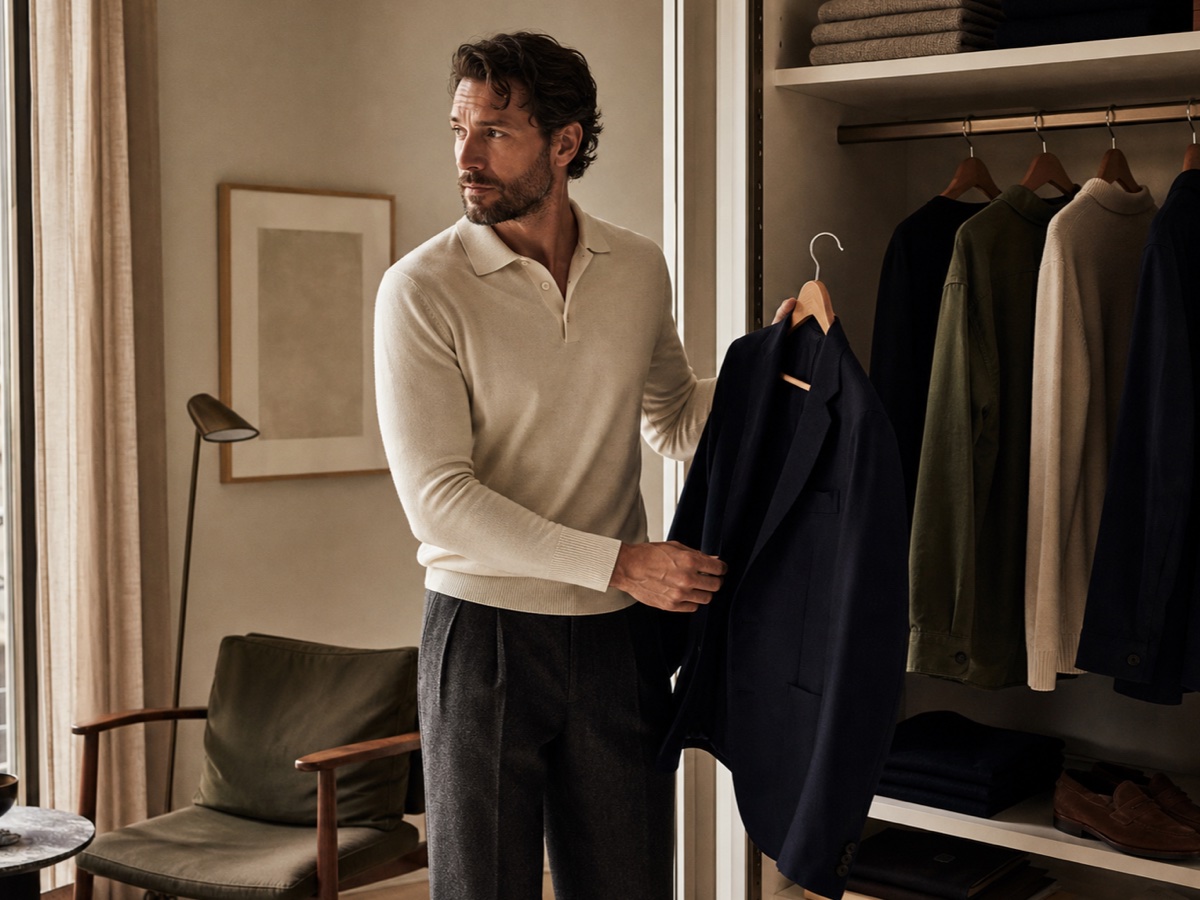
A business casual capsule wardrobe for men should make the working week easier to dress for. It should not be a Pinterest-coded grid of beige basics, or a list of pieces that look good on a mannequin and collapse the moment your calendar becomes real.
The useful version starts with your week. Calls, client rooms, travel, dinners, office days, warm weather, cold conference rooms, school runs, and the occasional event where “business casual” suddenly means three different things. The wardrobe has to absorb all of that without asking you to reinvent yourself every morning.
What business casual actually needs to solve
Business casual is difficult because it sits between signals. Too formal, and you look like you missed the current room. Too relaxed, and you look unfinished. Too trend-led, and the clothes start asking for attention you did not mean to invite.
For founders, executives, consultants, and senior operators, the goal is usually not to look fashionable. The goal is to look clear. Competent. Current. Relaxed enough for the way work has changed, but considered enough for the rooms where trust is being decided quickly.
That is why a capsule wardrobe can help, if it is built around function instead of fantasy. A good capsule reduces weak links. It gives every piece a job. It makes your outfits repeatable without making them look copied and pasted.
If your current wardrobe feels full but unreliable, start with the logic in a wardrobe audit for men. The audit tells you what is actually useful before you add more.
The core business casual capsule
For most men, the reliable business casual capsule starts with around 18 to 24 pieces. The exact number matters less than the relationship between them. You want pieces that share formality, color temperature, texture, and silhouette.
- 2 unstructured jackets or overshirts with enough polish for client-facing days
- 2 pairs of smart trousers, ideally in wool, cotton twill, or a refined technical fabric
- 2 pairs of chinos or five-pocket trousers that do not read too weekend
- 1 dark denim option, if denim is appropriate in your industry
- 3 to 4 shirts, including at least one oxford or brushed cotton shirt
- 3 to 4 knitwear or knit-polo options for days when a shirt feels stiff
- 2 refined T-shirts for layering, not gym-adjacent basics
- 2 pairs of shoes, one cleaner leather option and one smart casual option
- 1 outerwear piece that works over the whole capsule
- 1 belt, watch, bag, and small set of accessories that do not fight the clothes
This is not a universal prescription. It is a working frame. A man in finance may need more jackets and sharper shoes. A founder in a design-led company may need more texture, knitwear, and relaxed tailoring. A consultant who travels every week may need fabrics that recover quickly and pack well.
Start with trousers, not shirts
Most men build business casual from the top down. They buy shirts, polos, overshirts, and sweaters, then wonder why the outfits still feel random. The trousers are usually the real system setter.
Trousers decide the formality of the outfit before anything else gets involved. A washed chino, wool trouser, dark denim, pleated cotton trouser, and drawstring travel pant can all work in business casual, but they do not send the same signal. If the trousers are wrong, the jacket has to work too hard.
For a useful capsule, choose trousers in a narrow range of formality. For many serious men, that means one dark wool trouser, one mid-tone cotton or wool-blend trouser, one polished chino or five-pocket trouser, and one dark denim only if denim belongs in your actual rooms.
Use jackets to control the room
A business casual capsule needs at least one layer that can change the room instantly. This does not always mean a formal blazer. Often, an unstructured jacket, chore jacket in refined fabric, suede overshirt, soft wool overshirt, or casual sport coat does the job better.
The layer should make a plain outfit look intentional. T-shirt and trousers. Knit polo and denim. Oxford shirt and chinos. If the jacket only works with one outfit, it is not part of a capsule. It is a special case.
This is where many men lose money. They buy jackets they admire in isolation. Then the color, length, fabric, shoulder, or pocket style does not connect with the rest of the wardrobe. The jacket hangs there looking nice and unemployed.
Pick a narrow color system
A capsule wardrobe is not strong because it uses few colors. It is strong because the colors have a relationship. Navy, charcoal, olive, cream, tobacco, denim blue, brown, grey, stone, and black can all work. They just should not all compete in the same small wardrobe.
Choose one dark base, one or two mid-tones, and one lighter neutral. Then add texture before you add more color. A cream knit, olive overshirt, charcoal trouser, dark denim, tobacco suede shoe, and navy jacket can create more range than a larger closet full of disconnected shirts.
This is one reason generic capsule advice fails. It tells men what to own, but not how the pieces should speak to each other. The missing layer is decision logic.
Make room for your actual body
Business casual gets worse when the fit is almost right. A shirt that pulls a little. A trouser rise that shortens the body. A jacket that sits too high. A polo collar that collapses under a layer. These details are quiet, but they change how composed the whole outfit feels.
Your capsule should be built around the shapes that make your body look balanced. Some men need straighter trousers to anchor their shoulders. Some need a slightly higher rise. Some need softer jackets because structured shoulders add bulk. Some need more vertical line because short, chopped-up outfits make them look compressed.
That is why a proper personal stylist for men should diagnose fit and proportion before recommending products. A capsule is only useful if it fits the man wearing it.
Where men usually go wrong
The first mistake is copying a capsule from someone with a different life. A creative director’s business casual is not the same as a private equity partner’s, a SaaS founder’s, a lawyer’s, or a consultant’s. The clothes may overlap. The signal does not.
The second mistake is buying too many “versatile” pieces with no personality. Versatile can become bland quickly. You still need texture, proportion, and a point of view. Otherwise the wardrobe becomes easy to combine and hard to care about.
The third mistake is treating business casual as a dress code instead of a set of recurring situations. Your wardrobe does not need to satisfy an abstract rule. It needs to support Monday’s call, Tuesday’s client lunch, Wednesday’s airport, Thursday’s dinner, and Friday’s office without forcing five separate identities.
A simple outfit map
Once the capsule is built, the outfits should be obvious. You should be able to create a few reliable formulas without staring at the closet.
- Soft jacket, knit polo, wool trouser, leather loafer for polished client days
- Overshirt, refined T-shirt, five-pocket trouser, suede shoe for relaxed office days
- Oxford shirt, dark denim, unstructured jacket, clean leather sneaker for founder meetings
- Fine knit, smart trouser, light outerwear, minimal belt for travel days
- Open-collar shirt, textured jacket, dark trouser, brown shoe for dinners
These formulas are not meant to be rigid. They are rails. Once the rails are in place, getting dressed stops feeling like a new problem every morning.
When to get help
You can build a business casual capsule yourself if you have the time, taste, and patience to edit honestly. The hard part is not finding nice clothes. The hard part is seeing the pattern clearly enough to stop repeating the same mistakes.
Get help if your wardrobe is expensive but inconsistent, if you keep buying versions of the same safe piece, if your role has changed faster than your clothes, or if your calendar now requires a more accurate visual signal than it used to.
The Curated Outfit works with serious men who want wardrobe clarity without becoming menswear hobbyists. The Curated Reset is a virtual, application-only wardrobe system for men whose clothes need to catch up to the rooms they are already in.
If your business casual wardrobe is technically fine but still takes too much attention, that is usually a systems problem. The clothes are not only items. They are decisions. When the decisions connect, the week gets quieter.
Apply for The Curated Reset if you want the capsule, the fit logic, the shopping strategy, and the outfit map built around your real life.
FAQ
How many pieces should a men’s business casual capsule wardrobe have?
A men’s business casual capsule usually works well with 18 to 24 core pieces. The better question is whether the pieces create enough outfits for your real week. A smaller, connected wardrobe beats a larger closet full of almost-right options.
Can jeans be part of a business casual capsule?
Jeans can be part of a business casual capsule if your industry and rooms allow them. Choose dark, clean denim with minimal distressing and pair it with stronger layers, knitwear, or refined shoes so the outfit still reads considered.
What shoes work best for business casual men?
The best shoes are usually clean leather loafers, derbies, minimal leather sneakers, suede chukkas, or refined boots, depending on your climate and industry. Avoid shoes that are either too formal for the rest of the outfit or too sporty for the room.
Is a capsule wardrobe too boring for executives?
A capsule wardrobe is only boring when it is built from generic basics. For executives, the interest should come from fit, fabric, texture, proportion, and a clear color system. The result should feel calm, not anonymous.
Should I buy everything at once?
No. Buy in sequence. Audit what you own, fix the trousers and shoes first, add the layers that connect the outfits, then fill gaps. Buying everything at once often creates a new version of the same disconnected wardrobe.
If your wardrobe is full but your week still feels difficult to dress for, the issue is usually the system, not the amount of clothing.
Apply for The Curated Reset