To the 92% of men who hate the Google image result of their own name
I ran a small experiment with successful founders and leaders who say they care about personal brand.
The results caught my attention. From the outside, you can tell they care. The data shows a different level of follow-through.
A lot of men leave style near the bottom of the list. I understand why. They got this far without making it a real priority.
They built the business, earned the promotion, raised the round, and became the person people call when something has to get done. The next opportunity did not arrive because their trousers had the perfect break or their shirt fit cleanly through the shoulders.
So dressing well becomes one of those things they keep postponing. It rarely feels urgent enough for proper attention, yet it keeps creating small moments of friction.
Right before new headshots. At 2 AM while packing for a multi-day conference abroad. At a founder dinner they organized. Or when someone close to them makes a comment that lands a little too accurately.
This is not a random theory. I see it with clients, in my DMs, and now in the experiment I mentioned.
The data
I like data because it makes patterns harder to dismiss. So I built a quick archetype quiz to see how successful men think about their wardrobe, and whether it is actually serving the life they are in now.
The interesting part: the data confirmed what I already see and hear. The numbers simply made it sharper.
These men are not starting from zero.
Out of the first 97 results, 55% said they have a few go-to options for an important meeting. They are functional. They can get dressed without much friction and usually land somewhere decent. There is often a jacket or reliable piece they know will not embarrass them.
Only 18% said they know exactly what they are wearing and why.
That is the gap.
The wardrobe is not broken enough to create panic. It also is not clear enough to create ease. It works until the room asks for more precision.
It works for weekly meetings, for events with an obvious dress code, and for moments where they assume nobody is paying attention. Once the dress code gets vague, or the room includes Important People, the system gets cloudy.
I have also learned that the moments they call irrelevant, like school drop-off or working from home, still matter. Usually more than they admit out loud.
This is where style becomes less superficial than men want it to be
Your clothes are part of the signal you send, whether you have curated that signal or left it to chance.
Most founders know appearance matters. The blind spot is what specific clothes and style decisions communicate, and how much weight those decisions carry when opportunities are being formed around you.
Usually, more than you think.
You can have the track record, the taste, the judgment, the experience, and the competence. Still, people sense when something is off. Like the outer brand is trailing the actual person, even if they cannot explain it immediately.
When men say they "don't care about style," this is the part that gets missed. Being trendy or known as the most fashion-forward guy may never matter to them. Being taken seriously does. From the first impression onward.
And when one image sits on the company About Us page, the board page, interview thumbnails, and podcast artwork, you want to feel proud looking at it. I asked about that in the quiz too.
"If someone Googled you right now, would you be happy with what comes up?"
Only 8% answered with a clear, confident yes. The rest landed somewhere between "the results don't represent who I am" and "I'd rather people didn't Google me at all."
When nothing feels urgent enough to fix, it can stay unchanged for years. Eventually your track record is seven years ahead of how you look.
The good old "this'll do"
Playing it safe has a hidden cost. Safe often becomes forgettable: the same black tee, slightly tired jeans, and shoes bought because they "go with everything" while never making an outfit better.
That familiar "this'll do" uniform. The quiz data showed it too.
53% said they wear only half of what is hanging in their closet.
55% said they buy things here and there without a strategy.
41% said they stay with black, beige, grey, and navy because it feels like the safest decision.
People often assume the men who work with a stylist are moving from terrible style to a dramatic transformation. In my consultancy, that is rarely the real situation.
Most men are making an effort. The effort simply does not create the result they wanted because there is no clear direction. Without direction, the solution looks like another good piece.
A sharper jacket, another color of the same shirt, or the trousers that felt interesting in the store and a little too far outside your comfort zone after the tag came off.
For about two days, that can feel like progress.
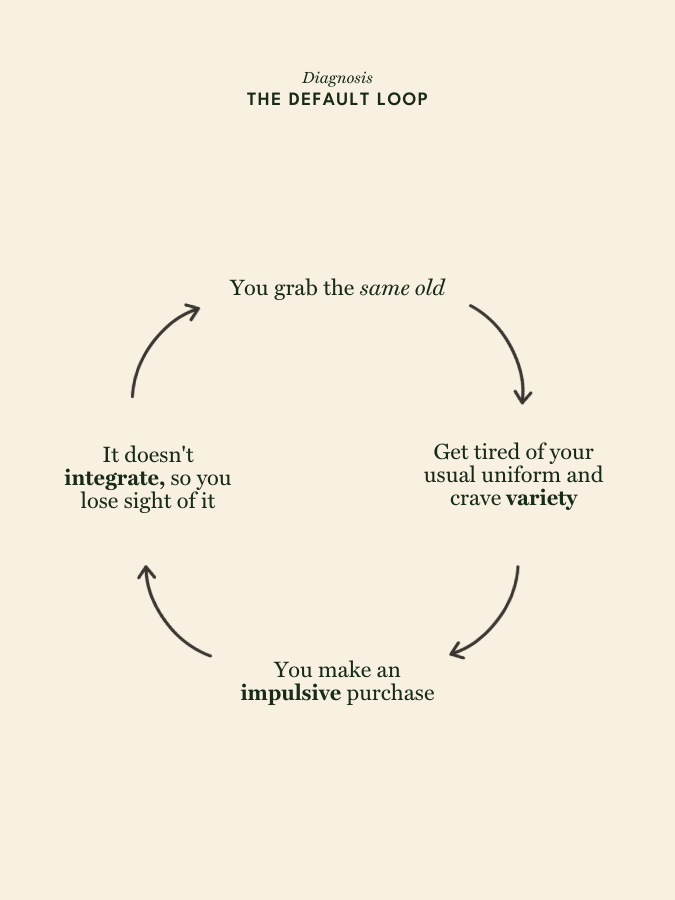
Then it becomes another isolated piece in the closet, hard to wear with the clothes you already reach for without resistance.
I call this the Default Loop.
The reason it is hard to fix is that your wardrobe often shows you who you still think you are. The guy who built it from scratch. The man who needed to look approachable, hungry, and low-maintenance. That version worked hard to get you here. He is also five years behind you.
Refining your image means accepting that you are no longer only the version who built the company. You are the version who runs it. Which brings us here.
How to break the Default Loop?
The same way you broke other ceilings. A plan. Iteration. A small amount of risk. Staying true to yourself. Dressing in a way that is accurate to your current life, instead of aspirational or stuck five years back.
A good wardrobe should remove friction. It makes an ordinary week easier. Helping before the occasional big event is a bonus. The main job is housing reliable outfit formulas for workdays, desk-to-dinner moments, travel days, and family weekends.
The best wardrobes?
They amplify who you are. They visually support your track record without making you feel like you are performing a role. People trust you faster when there is less confusion. They remember you more clearly and take you more seriously, especially when the outside lines up with who you are now.
The bonus: you get back something most successful men never seem to have enough of.
Time.
That is the real value.
Where to start?
The first step is to audit your style. Do it in 2 minutes with the Founder Style Archetype quiz & get 3 immediate wins to improve.
Take the quiz