Business Travel Outfits for Men
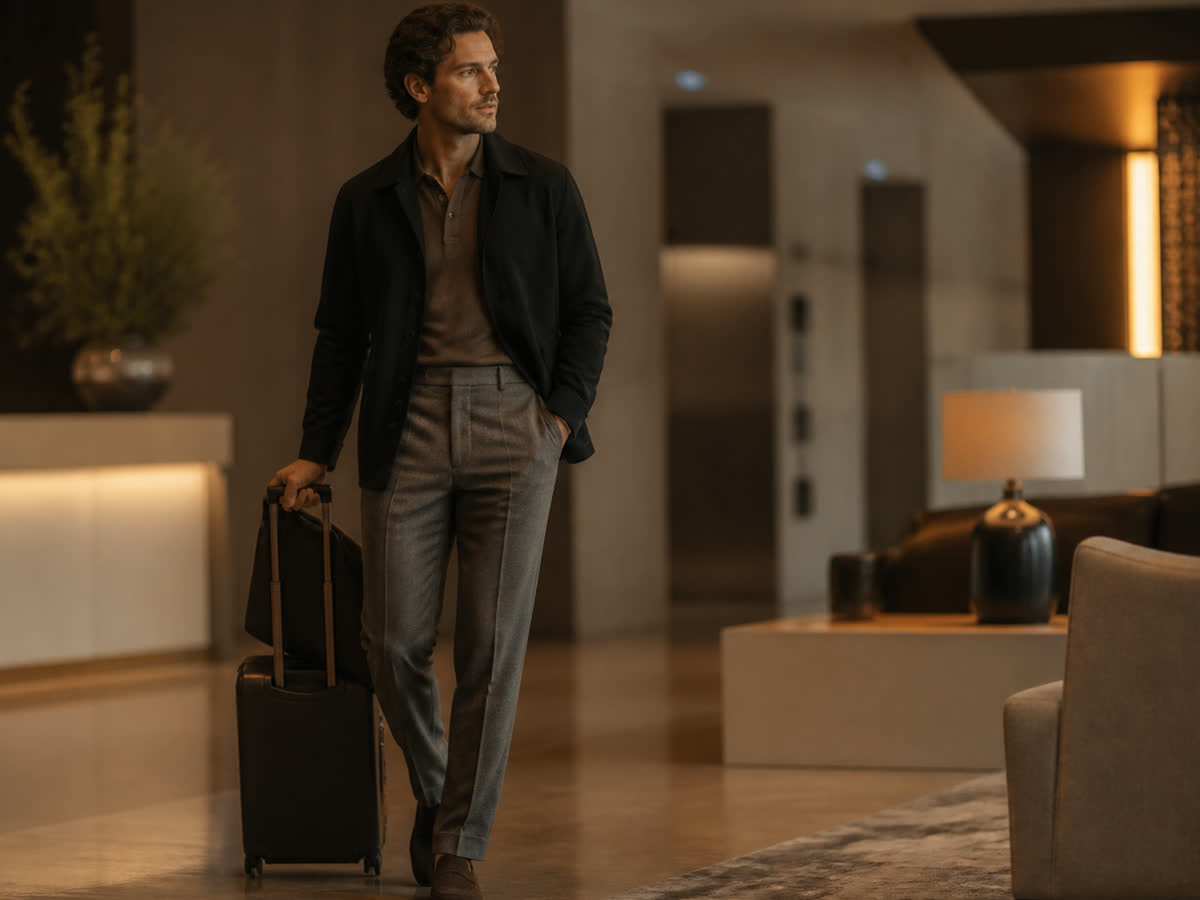
Business travel outfits for men have to do more than survive a flight. They need to look calm in the airport, appropriate in the meeting, sharp enough at dinner, and still believable when you are carrying a bag through a hotel lobby at 7am.
The common mistake is packing for isolated moments: one travel outfit, one meeting outfit, one dinner outfit, one emergency outfit. That creates luggage without creating a wardrobe. The better answer is a small system where every piece has a role and most pieces speak to each other.
For founders, executives, consultants, and senior operators, the goal is not travel comfort at the expense of authority. The goal is composed mobility.
Start with the itinerary, not the suitcase
Before you choose clothes, map the actual rooms. A two-day trip can include an airport, taxi, client office, internal workshop, hotel breakfast, strategy dinner, and one unplanned conversation where you still need to look like yourself.
Each room asks for a slightly different level of structure. The client meeting may need a jacket. The airport needs movement. Dinner needs polish. Breakfast needs ease without looking as if you gave up. If your wardrobe is built well, those needs overlap instead of competing.
This is why business travel sits close to business meeting dressing, but with more pressure on fabrics, layers, shoes, and repeatability. The outfit has to hold its shape after movement.
The best default travel formula
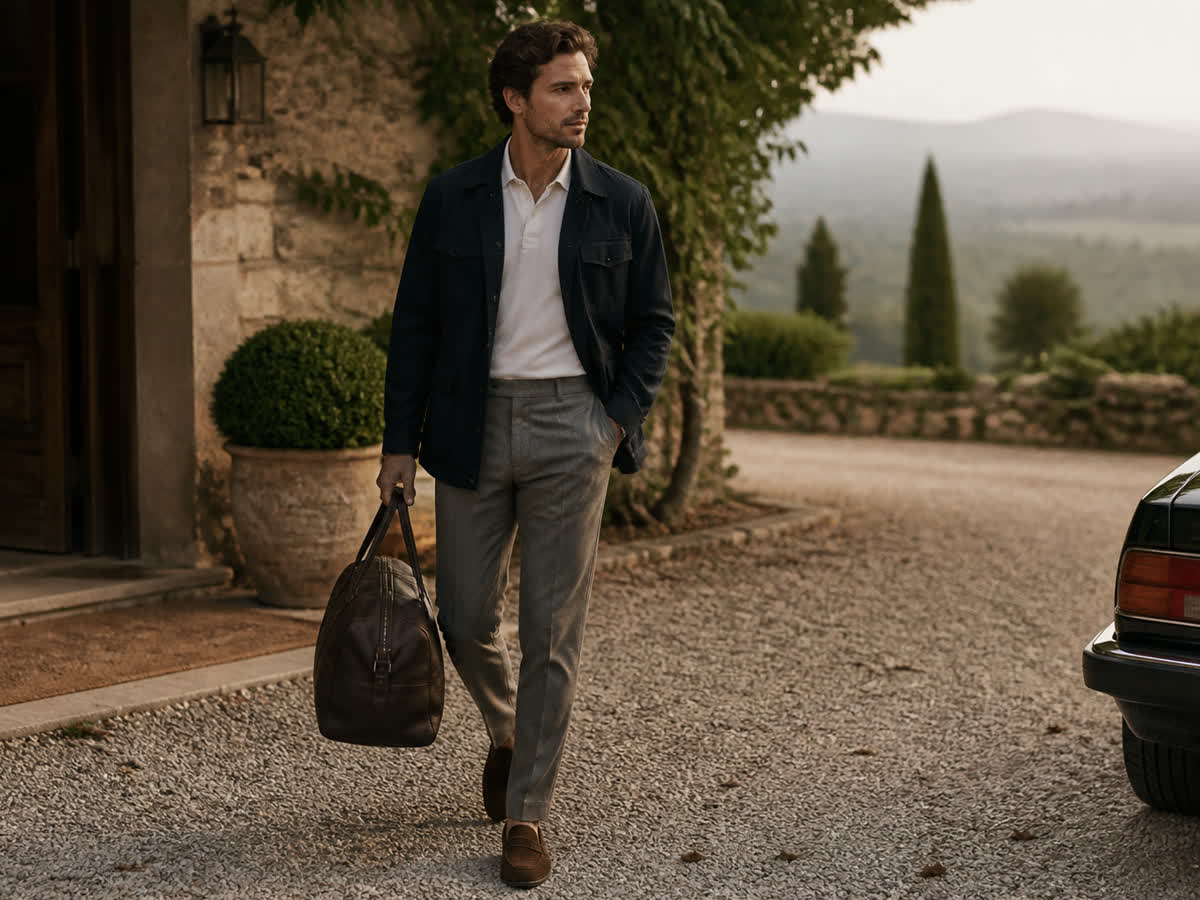
The safest default is a soft jacket or structured overshirt, a shirt or fine knit, tailored trousers, and refined shoes that can handle walking. It looks intentional without reading as a full office uniform.
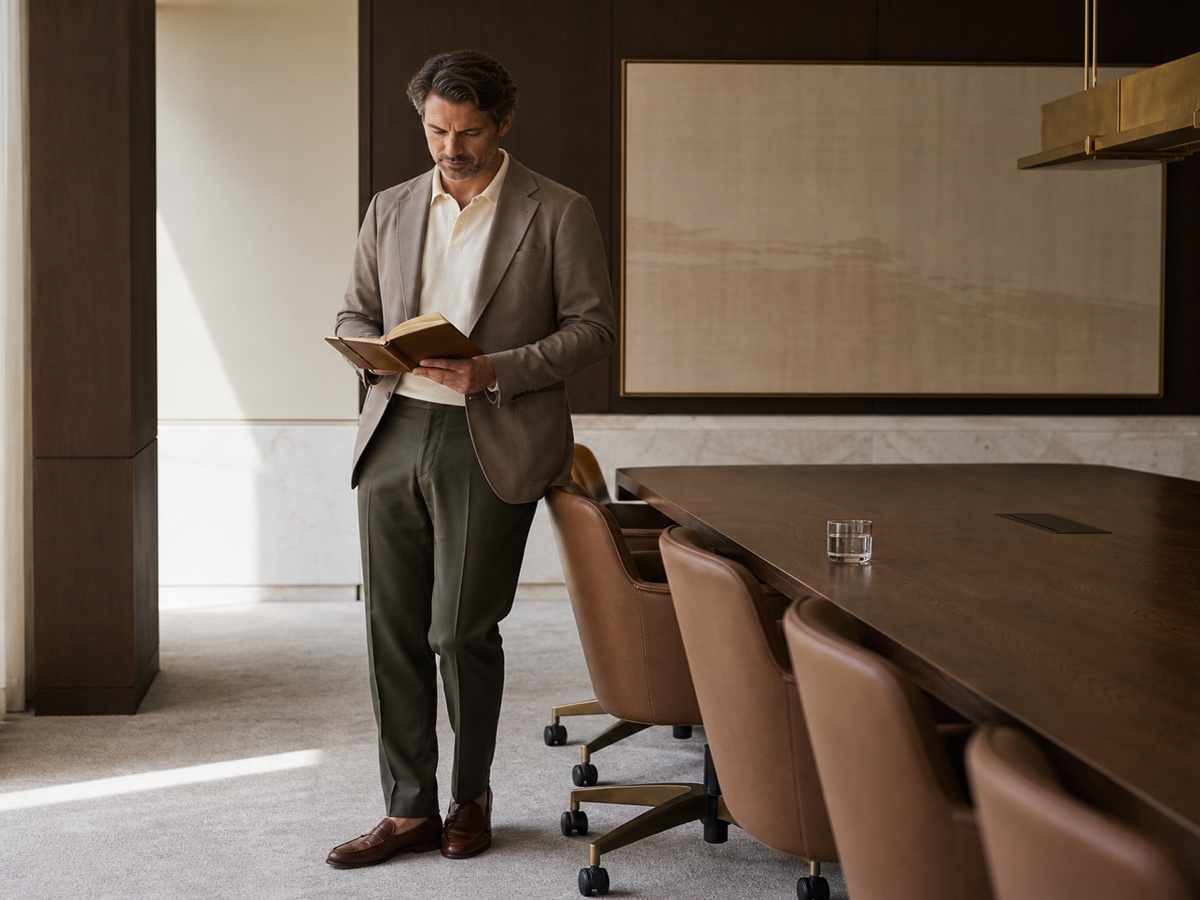
A navy unstructured jacket, pale shirt, grey trousers, and brown loafers will carry many trips. So will a dark overshirt, knit polo, tailored chinos, and suede derbies. These combinations are quiet, but they have enough line to keep your role visible.
Avoid building the travel outfit around the most comfortable item you own. Start with the most public moment of the trip, then soften from there. That small order change usually prevents the airport outfit from becoming the whole visual message.
Choose fabrics that recover
Business travel is hard on clothing because it compresses everything: sitting, heat, luggage, trains, taxis, dry airplane air, and long days. Cotton poplin, thin linen, and stiff tailoring can look good at home and tired by arrival.
Better fabrics recover. Wool trousers often outperform cotton chinos because they release wrinkles and hold a cleaner line. Fine merino, textured cotton, suede, flannel, and hopsack can look lived-in without looking messy. A soft jacket in a textured fabric is usually more forgiving than a shiny formal suit jacket.
If you travel often, this should be part of a wider founder wardrobe, not a separate travel costume. The same palette, textures, and silhouettes should work in your normal week.
Pack by combinations, not outfits
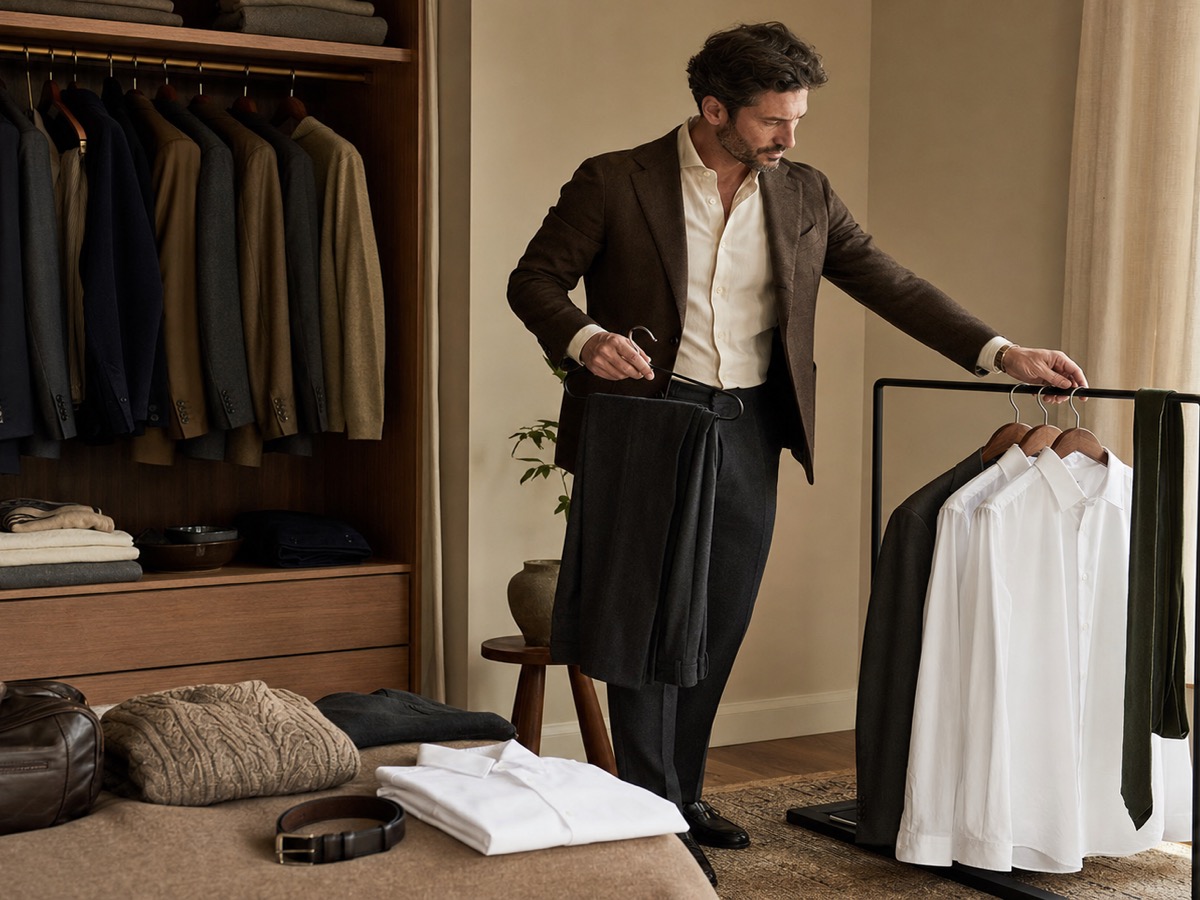
For a two-night business trip, most men need fewer clothes than they think. A useful capsule could be one jacket or overshirt, two tops, two trousers, one polished shoe, one travel knit, and one weather layer if needed.
The key is color discipline. Navy, grey, cream, olive, tobacco, brown, and soft blue tend to combine easily. High-contrast novelty pieces make a small suitcase harder because they only work once.
Do not pack a complete backup personality. Pack a coherent version of yourself with slightly different levels of polish.
Use one stronger travel piece
A business travel wardrobe often works better when one piece carries the structure. That could be a navy overshirt, a soft brown blazer, a dark knit jacket, or a well-cut chore jacket in a refined fabric.
This piece lets the rest of the outfit stay comfortable. It also gives you something to put on before entering a meeting, dinner, or hotel lobby. You should not need to rebuild the outfit every time the setting changes.
The same principle shows up in men’s wardrobe essentials: the right layer solves more than the right statement piece. It creates structure before anyone notices details.
Shoes decide how polished the outfit feels
Shoes carry a lot of the signal on business trips because trousers and jackets often stay quiet. Clean loafers, suede derbies, refined boots, or minimal leather sneakers can all work, depending on the trip.
If the trip is client-facing or dinner-heavy, bring loafers or derbies. If there is a lot of walking and the setting is modern, minimal sneakers may work, but they must look intentional. Running shoes should stay for actual exercise or transit-only moments.
One pair can often do the full trip if the color is versatile and the shape is refined. Brown suede is useful because it softens business clothing without making it casual in a gym-adjacent way.
What to wear on the plane or train
The travel outfit should be comfortable enough to sit in and sharp enough to arrive in. A knit polo or shirt, tailored trousers with some ease, soft jacket or overshirt, and loafers or clean sneakers is usually enough.
Avoid the hard split where you travel in sportswear and then change into a serious outfit. That split often creates friction and increases the chance of being seen in the least useful version of yourself.
If the flight is long, comfort matters. But comfort can come from cut and fabric rather than from looking like you are off duty.
What to avoid
- Shiny suit jackets worn with casual trousers because the textures rarely agree.
- Performance trousers that look technical under meeting-room lighting.
- Bulky sneakers that make the rest of the outfit look accidental.
- Too many colors for a two-day trip.
- Thin T-shirts under jackets when the day includes clients or senior rooms.
- Packing for every possible scenario instead of the real itinerary.
The issue is not that these pieces are wrong in isolation. The issue is that business travel exposes weak links quickly. A messy travel choice becomes the first impression before the meeting starts.
The simplest packing rule
Pack one level sharper than the airport requires and one level softer than the boardroom requires. That middle ground usually covers most business travel: mobile, composed, and visibly adult.
If you cannot build that middle ground from your current wardrobe, the problem is not the trip. It is the wardrobe architecture. There is probably too much separation between workwear, travel clothes, dinner clothes, and weekend defaults.
That is the kind of problem The Curated Outfit solves through The Curated Reset: a wardrobe system for serious men who need clothes to work across real rooms, not just look good in theory.
FAQ
What should men wear for business travel?
Men should wear a composed travel formula: a soft jacket or structured overshirt, a shirt or fine knit, tailored trousers, and refined shoes. The outfit should be comfortable enough for movement and polished enough for arrival, meetings, and hotel lobbies.
Can men wear sneakers on a business trip?
Men can wear sneakers on a business trip if they are clean, minimal, and appropriate to the setting. For client meetings, strategy dinners, or formal offices, loafers, suede derbies, or refined boots usually carry the outfit better.
How many outfits should a man pack for a two-day business trip?
For a two-day business trip, a man usually needs one jacket or overshirt, two tops, two trousers, one main pair of shoes, and one knit or weather layer. Pack combinations rather than full separate outfits so the suitcase stays small and coherent.
What fabrics work best for business travel?
Wool, fine merino, textured cotton, flannel, hopsack, and suede often work well for business travel because they recover better than stiff or thin fabrics. The best travel clothes hold a line after sitting, carrying luggage, and moving between rooms.
Conclusion
Good business travel style is not about packing more. It is about packing a smaller wardrobe that can move without losing its signal.
If every trip forces you to solve the same clothing problem again, the fix is not another emergency purchase. The fix is a wardrobe system with travel, meetings, dinners, and ordinary weeks built from the same point of view.