Business Casual for Men Over 40
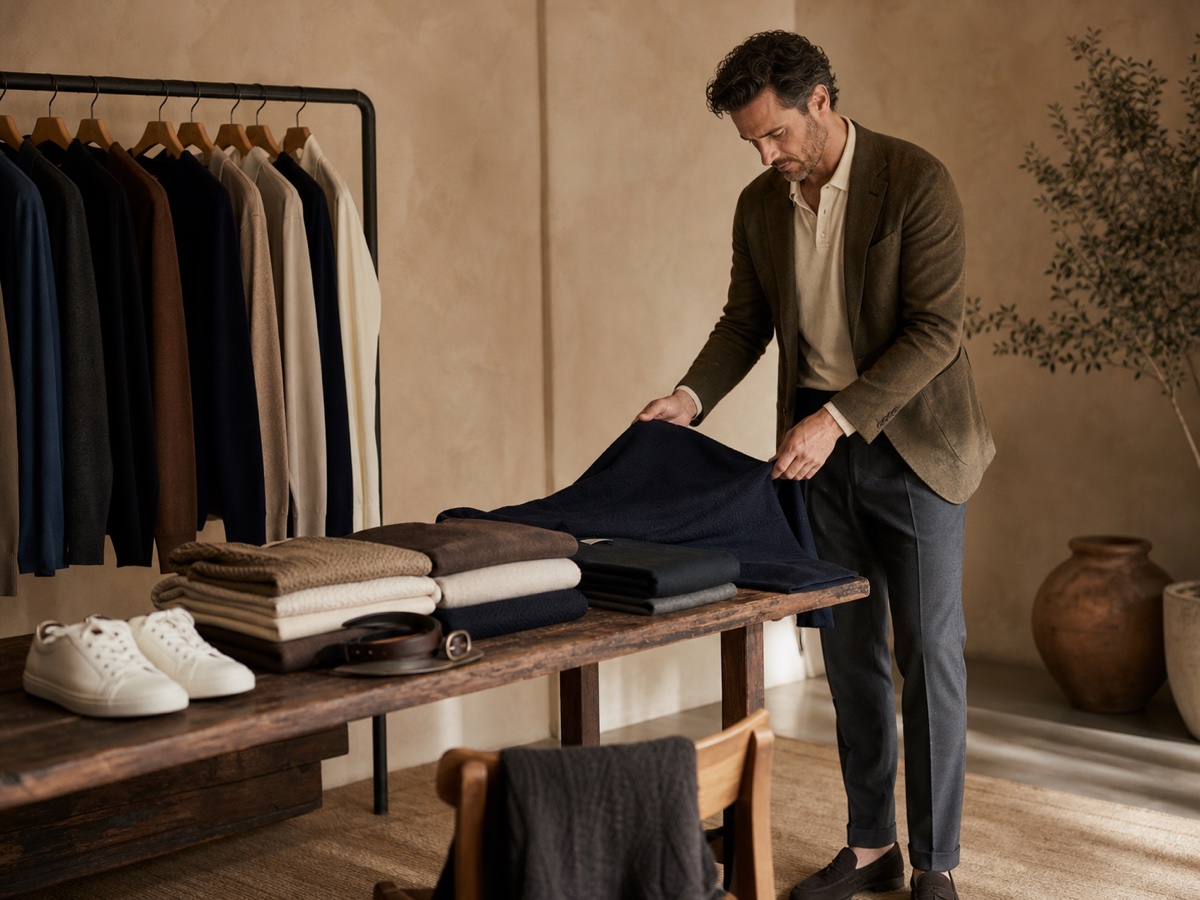
Business casual for men over 40 should make you look current, settled, and clear about the room you are in. It should not make you look as if you dressed for a younger office, copied a finance uniform, or gave up because the dress code got vague.
The problem is rarely the phrase itself. The problem is that business casual asks men to judge nuance: how formal, how relaxed, how sharp, how approachable, and how much personality belongs in the outfit.
Start with the room, not the dress code
Business casual means different things in a law-adjacent client meeting, a founder dinner, a creative boardroom, a consulting workshop, and a remote-first leadership offsite. If you start with the label, you end up with generic advice. If you start with the room, the outfit gets easier.
Ask three questions before you choose clothes. Who needs to trust you today? Will you be mostly sitting, presenting, walking, eating, or traveling? And should the outfit make you look more authoritative, more approachable, or more precise?
This is the same logic behind a strong executive personal style. Your clothes should be connected to your calendar. A man over 40 usually does not need more novelty. He needs cleaner decisions.
The baseline outfit that works most often
The most reliable business casual outfit for men over 40 is simple: an unstructured jacket or overshirt, a refined knit or open-collar shirt, tailored trousers, and leather shoes that are less formal than oxfords. This gives shape without stiffness and ease without looking casual by accident.
For most founders and consultants, start with navy, olive, taupe, charcoal, espresso, cream, and muted blue. These colors look adult without becoming heavy. They also combine better than high-contrast black and white if your daily work is more strategic than ceremonial.
The pieces should be quiet, but they cannot be vague. A soft blazer still needs shoulder shape. A knit polo still needs a collar that sits cleanly. Trousers need drape. Shoes need intention. Business casual fails when every item is almost right.
Upgrade fit before you upgrade brands
Men over 40 often own better clothes than they think. The issue is proportion. Jackets are too long or too padded. Trousers sit too low. Shirts pull at the stomach. Knitwear is either thin and clingy or bulky enough to blur the frame.
Fit should create a calmer outline. You want enough room through the body to move and sit, enough structure at the shoulder to hold the eye, and enough taper in the trouser to look intentional. Tight rarely looks senior. Oversized rarely looks precise.
If this keeps showing up across your wardrobe, start with a wardrobe audit. The audit will show whether your business casual problem is fit, color, formality, fabric, or disconnected pieces.
Choose fabrics with more substance
Texture is one of the easiest ways to make business casual look grown up. Wool hopsack, brushed cotton, fine corduroy, merino, suede, flannel, linen blends, and heavier oxford cloth all read more considered than flat, shiny, office-store fabric.
Substance also helps the body. A good knit polo can sit better across the chest than a thin T-shirt. A wool trouser can clean up the leg more than a stretch chino. A suede loafer can soften an outfit while still looking deliberate.
This is where many men accidentally dress too young. They keep the silhouette of a college casual wardrobe and buy more expensive versions of it. At 40, the better move is often to keep the ease and improve the shape, fabric, and finish.
Build three business casual levels
You do not need endless outfits. You need levels you can repeat.
Level 1: relaxed leadership day
Use this for internal meetings, focused workdays, and low-stakes team settings. Try a merino polo or fine crewneck, tailored drawstring trousers or clean chinos, and suede loafers or refined sneakers. Add a chore jacket, overshirt, or knit jacket if you need more shape.
Level 2: client-ready business casual
Use this when you are meeting clients, advisors, investors, or senior partners without needing a suit. Wear an unstructured blazer, open-collar shirt or knit polo, wool trousers, and loafers, derbies, or clean Chelsea boots. This is the level most men should have ready at all times.
Level 3: polished without a tie
Use this for board-adjacent rooms, important dinners, conferences, and visible moments where a full suit may feel stiff. A soft suit worn as separates, a textured jacket, a pale shirt, refined trousers, and darker leather shoes usually give enough authority.
If you travel often, these levels can turn into a compact system. The same jacket can work for a client dinner, a business meeting, and a conference if the layers underneath are chosen properly.
Business casual mistakes that age the outfit
The first mistake is relying on chinos and a shirt for everything. That combination can work, but it often looks like the default outfit of a man who stopped deciding. Add texture, better shoes, a stronger collar, or a jacket with softness.
The second mistake is overcorrecting into formality. A stiff navy blazer, thin dress shirt, polished oxfords, and corporate trousers can make modern business casual feel dated. If the office has relaxed, the tailoring needs softness too.
The third mistake is treating sneakers as a shortcut to modernity. Some sneakers work, especially clean leather or suede styles with quiet soles. Many do not. If the sneaker makes the outfit feel younger than your role, choose loafers, derbies, or boots instead.
The fourth mistake is ignoring grooming and condition. A business casual outfit depends on clean lines. Scuffed shoes, stretched collars, tired knitwear, and trousers that have lost their press will quietly undermine everything.
Where personality belongs
Personality does not need to be loud. It can sit in a brown suede loafer, a soft olive jacket, a textured belt, a shirt with a better collar, a watch you actually like, or a knit with the right depth of color.
The question is whether the detail supports the man. If a print, bright color, or unusual shoe becomes the first thing people notice, it may be doing too much. For the TCO client, personality usually works best as a consistent signal, not a surprise.
A practical wardrobe system makes this easier. Once your palette, fit standards, and outfit formulas are clear, you can add interest without having to rethink the whole wardrobe.
What to buy first
If your business casual wardrobe feels unclear, do not start with accessories. Start with the pieces that change the most outfits.
- A soft navy, olive, brown, or charcoal jacket that works with trousers and dark denim.
- Two refined knit polos or fine-gauge knits in cream, navy, brown, or muted green.
- One pair of wool trousers and one pair of clean chinos with a proper rise.
- One leather loafer, suede loafer, derby, or Chelsea boot that feels current.
- A small set of shirts with collars that sit well open, not only under a tie.
Buy less if the system is unclear. Buying more into confusion only gives you more combinations that almost work.
Where The Curated Reset fits
The Curated Reset is for men who want business casual to stop being a daily negotiation. We build the wardrobe from the real calendar: leadership days, client rooms, travel, dinners, photos, offsites, weekends, and the normal Tuesdays that still count.
Inside the process, we define your fit standards, palette, formality levels, outfit formulas, shopping direction, and implementation rules. The goal is not to make you interested in menswear. The goal is to make your wardrobe congruent with the man people already rely on.
If business casual is where your wardrobe keeps getting vague, apply for The Curated Reset. We will build the logic before we add more clothes.
FAQ
What is business casual for men over 40?
Business casual for men over 40 is polished clothing with enough ease for modern work. It usually means soft tailoring, refined shirts or knitwear, tailored trousers, and intentional shoes rather than a full suit or casual weekend clothes.
Can men over 40 wear sneakers for business casual?
Yes, men over 40 can wear sneakers for business casual when the sneakers are clean, minimal, and matched to the room. Leather or suede styles work better than athletic sneakers. If the meeting is senior or client-facing, loafers or derbies are often safer.
Are jeans business casual for men over 40?
Jeans can be business casual if they are dark, clean, well-fitting, and paired with stronger pieces such as a soft blazer, knit polo, or refined shoes. Faded, distressed, skinny, or overly relaxed jeans usually make the outfit feel too casual.
What colors work best for business casual after 40?
Navy, charcoal, olive, taupe, espresso, cream, muted blue, and soft white are useful business casual colors after 40. They give range without looking loud and combine easily across jackets, trousers, knitwear, and shoes.
How many business casual outfits does a man need?
Most men need fewer outfits than they think. Three to five reliable formulas can cover most weeks if the pieces combine well. A good system matters more than a large closet.
If you want business casual to feel clear across your real week, apply for The Curated Reset.